Book of Revelation – Chapter 2
The letters that John wrote to the seven individual churches apply to all churches of all ages, for these seven churches represent seven stages of church history. Let us see what the Lord had to say.
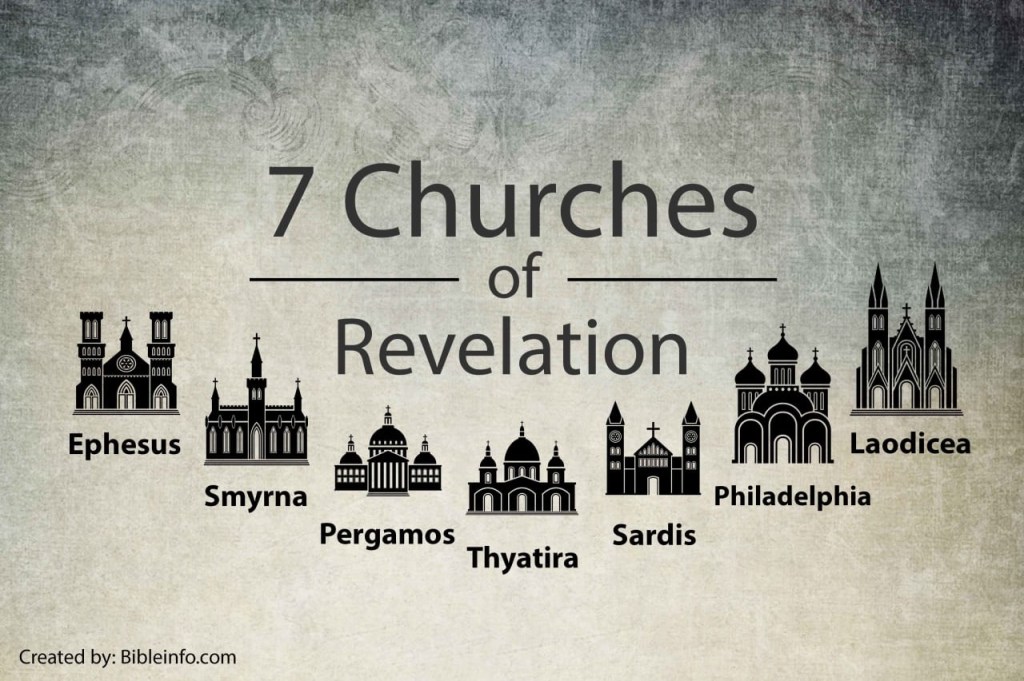
Ephesus church covers the approximate period of 33 A.D. to 100 A.D. Christ commends that local assembly before scolding them for their sins. Notice that it is not wrong to judge someone when that individual’s doctrine is heretical, or wickedness fills a person’s life. We are to “Try the spirits whether they are of God because many false prophets are gone out into the world.” (1 John 4:1). The church at Ephesus was strong when it started but slipped from its original moorings and was on the way down. Though busy and outwardly sound, it shifted away from its love for Christ. Ephesus lost its first love. They may have been too busy serving and not taking time to fellowship with Jesus. When one is so active that they have no time for Bible study and prayer, they are too busy. Been there and done that! Let us not lose our first love. Remember, repent, and do the first works.
Smyrna church covered 100 A.D. to 312 A.D. when the most significant persecution in all Christianity took place. This church had works of faith that brought great tribulation and material poverty. Yet, they spread the Word of God to the entire Roman Empire. They experienced martyrdom with an estimate of nearly 5 million killed. Death was commonplace. Regardless, the church flourished and grew during the Smyrna period. However, the church developed ritualism or a deliberate Judaizing of Christianity. False professors of religion brought much heartache. We should beware of those who claim to be Christians but deny the deity of Christ (1 John 4:3). Also true of those who mix law and grace in their teachings. Smyrna was experiencing persecution from within and without. When our hour of trial comes, we are not to fear but to keep our eyes on Jesus and the eternal rewards He promised (James 1:12).
Pergamos was the faltering church, extending from 312 A.D. to 606 A.D. Materialism, self-indulgence, and worldliness described the church in Pergamos. You might say that it was adrift or had backslid; a marriage of the church and the world. Of necessity, the believer in Christ is in the world. They must constantly guard against becoming involved in the world’s ungodliness. There appeared to be two false creeds in the church:
(1) the doctrine of Balaam – “Let’s be more relaxed in our loyalties.”
(2) the doctrine of the Nicolaitanes – “Let’s be more restricted in our leadership.” An example is when the ministry or leader says, “I am the head, and you have no choice in the matter,” allowing laymen no voice in the church’s affairs.
Christ’s call is always to the individual believer in these churches. Let’s keep ourselves from immorality and refuse to partake in the loose living around us. Be an overcomer. The white stone represents the changeless purity of Christ.
Thyatira church covers the years of 606 A.D. to 1520 A.D. It started with a commendation from the Lord. She was known for her good works, love, service, faith, patience, and last works, loaded with excellent service and unusual deeds. This church outdid itself. Many scholars believe that this church is still found in the world today until the revived Roman Empire destroys it in Revelation chapters 17 and 18. The church resisted doing what was right and expected. Judgment always comes. The Lord Jesus Christ searches the minds and hearts and will give every one according to their works. Consider that we don’t lose those rewards we have earned (2 John 8). Even here at Thyatira, a remnant remained faithful despite the deterioration of their local church. In verse 28: Christ has promised faithful believers three rewards upon His return to the earth:
- Rulership over the nations during the Millennium (chapter 20, verse 4),
- Sharing in this glorious time of perfect righteousness resulting from Christ’s enforcement and order (Psalm 2:8,9), and
- The abiding presence of the blessed Savior throughout time and eternity as Christ himself, the bright and morning star, reigns (chapter 22, verses 14, 16).
Next, we will continue with the other churches.
Book of Revelation – Chapter 1
The word revelation means unveiling or uncovering. The Roman government exiled the apostle John on a rocky island in the Meditteranean Sea. During his time there, John had a vision given directly by God to write what he saw. John gave details to everything he heard or witnessed. This book is about the unveiling of Jesus Christ and to show His servants things that “must shortly come to pass.” Here we learn that “shortly” means rapid action once there is a beginning. So we enter into a study of signs as we proceed.
Christ has bestowed upon all believers the majesty of a prince and the ministry of a priest. Reading the book of Revelation is a blessing. But there is a blessing to be received for just hearing Revelation read. Don’t put aside this book because it deals with future events. John Phillips, in his commentary, says, “The events it predicts can happen at any moment; not immediate, but imminent.” Let us not forget how short time is and how long eternity lasts.
The number seven (7) will come up again and again. Remember that seven is God’s number of perfection and completeness. Christ holds seven stars, walks among seven candlestands, and instructs John to write what he hears and witnesses to the seven churches in Asia Minor, which are Ephesus, Smyrna, Pergamos, Thyatira, Sardis, Philadelphia, and Laodicea.
We understand Christ as the beginning and ending of all things. He was, is, and always will be. While believers are in this world, they will have tribulation (see John 16:33), but in verse 9, this does not include the Tribulation hour. Kept out of this hour are the saints. It is “the time of Jacob’s trouble.” as stated in Jeremiah 30:7.
Clothed in the garment of an Old Testament high priest, Christ is about to enter into judgment with the world. Swayed by neither pity nor passion, He executes justice that will come swiftly. Bright whiteness speaks of His righteousness. The fire in His eyes reflects the righteous anger concerning the sins of the churches. Christ’s feet picture judgment and relate to the events when He returns to earth.

The seven stars are the seven messengers to the seven churches. Christ “has complete control over all forces, known and unknown, natural and supernatural, seen and unseen, that shape the destinies of men.” (John Phillips commentary). The two-edged sword is the Word of God.
Hades, Sheol, and Hell – what are they?
Sheol (an Old Testament term) and Hades (a New Testament term) are the same. Hades was a place where all humans’ souls and spirits went until the cross of Christ. There existed two compartments; one for the wicked and the other (known as Paradise) for the righteous. Paradise is where Christ went upon His death (Acts 2:27, 31). He ministered there to His people and led captivity captive (Ephesians 4:8-10). This act released them to enter the third heaven of 2 Corinthians 12:2. Presently, the comfort side of Hades (Paradise) is empty. Fully occupied is the torment side of Hades. On the White Throne Judgment day, God will open Hades’ torment side as told in Revelation 20:13, when death and hell (or Hades) must deliver up the dead. Judgment awaits the wicked.
Written chronologically, the Book of Revelation presents past (were), present (are), and future (shall be) events. Chapter 1 (past), Chapter 2 and 3 (present), and Chapter 4 through 22 (future).
Now we proceed to the seven churches of chapter 2 and chapter 3.
Bill Wyler
 More from Bill
- An error has occurred; the feed is probably down. Try again later.

-
Archives
- April 2025 (1)
- February 2025 (1)
- January 2025 (6)
- December 2024 (1)
- April 2024 (4)
- March 2024 (4)
- February 2024 (6)
- January 2024 (8)
- November 2023 (1)
- July 2023 (1)
- June 2023 (1)
- May 2023 (1)
-
Categories
-
RSS
Entries RSS
Comments RSS
 Reviews and Views