Another Reason to Start Savings
From an article written by Justice Litle, July 14, 2009, entitled “Guess What Really Brought Us out of the Great Depression?” at http://financesense.com/editorials/2009/0714.html
Consumer savings is usually overlooked as to the real reason the US got out of the Great Depression. World War II moved millions from unemployment rolls to the military. Unemployment nearly vanished in months. However, scarcity became a problem for every citizen. Income levels rose. Women were needed as much as men to fill job openings. Because the country was on a war footing, a sort of “forced savings effort” was in place. Families had to make do on an “austerity budget”, and wound up banking much of what they earned. 25 cents of every $1 earned was set aside, which setup the stage for an explosion of consumption in the years that followed the War.
This generation is never going back to “the way it was.” However, there will be new mistakes, new insanities, and new bubbles for now and the foreseeable future. We have a lot of savings to do.
Old New England maxim: “Use it up, wear it out, make it do or do without.”
Hard Times by Richard Benson
3 questions and 3 observations were made by Richard Benson in his article Hard Times. See the original article at http://www.financesense.com/editorials/Benson/2009/0709.html
Mr. Benson asks a relevant question about how to determine just how bad is the economy. There are three basic questions:
- Are people working? Are people actually employed?
- In 2009, less than 20% of graduating college students had jobs lined up after graduation. Compare that to 51% in 2007.
- Official unemployment rate is currently around 9.5%. However, when you include those who are not eligible for unemployment benefits, those who want to work but stopped looking, those who are underemployed, and part-time workers who want full-time employment the percentage is much higher (more than double).
- Are they (those working) making any money?
- Take a look at tax collections as a way to measure income. In general state income tax receipts from Jan 2008 to April 2009 were down 26% from the year before.
- The Georgia Department of Revenue reported on July 1 that tax collections had declined 16 percent to $1.36 billion in June compared to June of last year. For the full fiscal 2009, which ended on June 30, revenues were down 10.5 percent. Atlanta Business Chronicles, July 21, 2009.
- You can see more details in a similar article from the Atlanta Business Chronicles, dated July 10, 2009.
- Do they (those still working) have any money in reserves? Does anyone have any financial resources?
- Though the savings rate has increased, the numbers are questionable.
- Cash in the bank is real savings. Paying down credit card debt is not.
- The number of people collecting food stamps is rising by 4 million per year. To be eligible for food stamps, you need to have less than $2,000 in resources such as a bank deposit.
Benson recaps the following points:
- 7 million people are collecting unemployment benefits.
- 8 million people are unemployed and collecting nothing.
- 2.4 million people are in jail (1 in 100 adults).
- 51 million are collecting Social Security.
- 12 million more are collecting Social Security Disability.
- 34 million are on food stamps.
Finally, Mr. Benson makes the point that we are experiencing hard times the likes of which most of us have never seen. The economy is dying and the American press is not focusing on the real economic statistics nor are most of the politicians. He urges all of us that “It’s time to get grumpy and politically active!”
PERSONAL: I would like to add that it is time to pray for God’s mercy and wisdom during these “hard times”. Perhaps He will be so inclined.
What to Do Right Now.
Here are a few things that you might consider doing right now for yourself and your family.
- Payoff your credit card balances. Most of us cannot do this all at once. As you work on the minimum payments of each card, strive to pay off the lowest/smallest balance first. Then put that paid card’s minimum payment together with the second lowest card balance payment. Continue until all cards are paid off. This all assumes that you will not continue to make new charges. This reduction of expensive debt should be your first order of business. Pay down these balances even before considering any retirement savings or stock market investments.
- Budgeting and staying on one is lots of work. It is harder for some than others. Everyone should know where your hard-earned money is going. If you do that is a good thing, because you are in the position to make changes as needed. By knowing, you can look for ways to save money and set aside some for a “rainy day”. One of my favorite websites that might be helpful is http://www.moneyrulesdebtstinks.com [Have fun with the process.]
- As you control your spending and pay off expensive credit card debt, you should begin to set aside a few extra dollars. Place your extra dollars in some type of “interest-bearing” account. Shop around among the various banks and credit unions for the best rates. As of July 2009, The Bank of Georgia in Peachtree City has a checking account that earns 5% on deposits upto $25,000. Not bad when many are offering very little to nothing. Today some of the banks are not that stable due to commercial loans losses and other bad investments. Georgia has more than its share of failed banks. Deposits are FDIC insured, but best to do your homework and investigate. The general advice I hear is to work toward a balance of 6-months of your earnings into savings. Each of us should do what we can with what we have. If you manage one-month of earnings in savings, you are ahead of most people. Just keep at it consistently over time and you will achieve the amount you need and feel comfortable with it.
- By now, you are ready to make a longer-term investment. Today, where to place your money for the long-term is uncertain. Many advisors and so-called experts are more than willing to “sell” you on their ideas for a substantial gains while minimizing the risk. There a few good financial advisors, but remember that no one has a crystal ball and no one knows the future. Do your own research. Think for yourself.
- A final word, whatever you decide to do, please don’t ignore common sense. Your personal finances are really all about common sense and are not to be gambled with. Some risk will be necessary. After you have eliminated your high-cost credit card debt, started a family budget, and built a 6-month reserve; you are ready to invest wisely.
Best to be prepared for whatever the future may hold.
The Age of the Unthinkable by Joshua Cooper Ramo
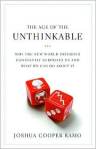
Ramo in his new book lays out a compelling challenge about a world under change. Though he speaks in terms of international diplomacy, much of his thinking can be applied to every organization and system. If nothing else, he calls for preparedness because change is coming whether we wish it or not or want it or not. What follows is a recap of some of his comments on the subject of change.
Change has always been around us and in our lives. You may have sensed that the frequency of change has quicken. Sometimes without warning, it “roars down upon us as an avalanche out of bounds and out of our control.” These numerous changes are causing once-given landscapes to disappear or reshape into unfamiliar forms.
The time has arrived for adaptive systems and organizations. The future will require flexibility and preparedness for the type of intense change ahead. We will see “maladaptive systems (which) might look good for awhile, but when they are hit with the unexpected, they react in ways that doom them.” These systems are “organized into instability.” Many are “blinded by optimism and confusion (by) using out-of-date and unrealistic models of the world (their world).” It is the small things that precipitate an avalanche of change that must run its course until its energy is spent. Unfortunately, “we are probably not going to see it until it is too late.”
Any “change produces unpredictability and surprise.” So when “we push for change – we have to prepare ourselves for the fact that much of what we’ll get is unpredictable.” The time has come “to accept growing complexity and ceaseless newness as givens.”
Our future will require “harder truth telling” and experimentation that takes us right to the very edge of collapse. We will need to focus on things that move & change and learn to ask unusual questions. “We should do the work of crisis before crisis becomes a reality.” Much of the change ahead of us “will be difficult. It will involve tremendous sacrifice.”
Finally, you should realize that any discussion of this book will be highly frustrating because you will typically find “only incomprehension or dismissal in your audience.” To understand what the central message of this book is about will require an “intellectual and spiritual leap” and for most that will be too much to ask.
This age is the only one we have. It is now our time to face a changing world unlike anything those before us dealt with. What will it demand of you and me?
Personal: I highly recommend this book. It should challenge your thinking and cause you to think thoughts that might surprise you. Please don’t dismiss it’s message too quickly. Bill Wyler
The Day the Mall Died
From an article by Anthony Cherniawski…
“Our consumption-driven society is being turned on its head, leaving household names staring down the barrel of bankruptcy. So many thing we have accepted as ‘absolute givens’ are goint to be stressed to the breaking point. One of them is the MALL – that icon of consumption itself. In fact, on April 16, 2009, ‘The MALL’ as we know it actually died. That was the day Chicago-based General Growth Properties (GGP) – the second-largest mall owner in the United States – filed for bankruptcy in federal court.”
Refer to http://financialsense.com/fsu/editorials/cherniawski/2009/0626.html.
Personal: Some say our generation will see “ghost malls” across this land – vacant store fronts where retail businesses brought products and services to US consumers but cannot because the profits are no longer there.
Bill Wyler
 More from Bill
- An error has occurred; the feed is probably down. Try again later.

-
Archives
- April 2025 (1)
- February 2025 (1)
- January 2025 (6)
- December 2024 (1)
- April 2024 (4)
- March 2024 (4)
- February 2024 (6)
- January 2024 (8)
- November 2023 (1)
- July 2023 (1)
- June 2023 (1)
- May 2023 (1)
-
Categories
-
RSS
Entries RSS
Comments RSS
 Reviews and Views