Question: What is the answer to Jerusalem and Israel?
This is an excerpt from Joel Rosenberg’s Flash Traffic at http://flashtrafficblog.wordpress.com
The Hebrew Prophets such as Ezekiel, Daniel, Isaiah, Jeremiah and Joel tell us again and again that Israel will be all alone in the last days of history. All the nations will eventually turn against her. All the nations will work to divide the Land of Israel. Jerusalem, too, will be divided. The New Testament reconfirms this. Indeed, the Scriptures indicate that the only hope for Israel is for her to turn fully and completely to the God of Abraham, Isaac and Jacob. As the “time of Jacob’s troubles” approaches — as the Day of the Lord approaches — the Bible tells us that the nations will betray the Jewish people. Only the Lord will be faithful. The question is, when the dark times come will Israelis turn their hearts to the Lord?
The Hebrew Prophet Joel warned us that the Lord is going to judge “all the nations” because “they have divided up My Land.” (Joel 3:2) Yet Joel doesn’t call Israel to political activism, to international diplomacy, to military adventurism, or any other human endeavor. The Lord says through the Prophet Joel, “‘Yet even now, return to Me with all your heart, and with fasting, weeping and mourning; and rend your heart and not your garments’…Now, return to the Lord your God for He is gracious and compassionate, slow to anger and abounding in loving kindness and relenting of evil.” (Joel 2:12-13) And if Israel does this, Joel tells us: “Then the Lord will be zealous for His land and will have pity on His people.” (Joel 2:18, 27)
The Prime Minister’s speech to Congress was excellent in many ways. He rightly described the “epic battle” underway in the epicenter. He described a great shaking going on in the Middle East. He rightly warned that Iran and her nuclear program is the greatest threat, that Hamas is the new al Qaeda, and that in all of the Arab world, only Israeli Arabs have true safety, security, and fully protected human and civil rights. However, it should be noted that Netanyahu never cited the Bible, never called on the name of the Lord, and never called the Jewish people to trust fully and completely in the God of Israel, but rather promised to divide the land of Israel as a concession to the Palestinians, even while promising never to divide Jerusalem. These were mistakes. He wasn’t the first Israeli Prime Minister to make them. But he is making them nonetheless. He was right to thank the U.S. for all our help and support of Israel over the years, and he was right to seek continued help and support from the American people and government. But neither he nor Israel should become dependent upon American help because the Bible tells us it won’t be there for long.
The Bible is clear: only the Lord will save Israel. It is time for Israelis to consider this very carefully. For time is short. “The Day of the Lord is coming; surely it is near.” (Joel 2:1).
Bill Wyler: This same could be said for America; calling on the name of the Lord God for our own redemption and help in times of trouble.
How to Defeat the ALINSKY Method of Maneuvering Meetings Toward Preset Goals.
1st Rule: SMILE! Always be charming, pleasant and courteous. Speak in a normal voice. Avoid seeming or appearing to be belligerent or aggressive.
2nd Rule: STAY FOCUSED! To help you stay on track, write your question or statement down in advance.
Watches for “change agents” to twist the conversation around to make you (the questioner) appear foolish or belligerent or aggressive. Be careful to not go on the defensive. Remember the 1st Rule. Always bring them back to the question by simply stating clearly and precisely: “That is NOT what I stated. What I asked was…” (here repeat your original question).
3rd Rule: BE PERSISTENT! Realize that the Facilitator will probably go into some long drawn out discussion of some unrelated or only vaguely related subject. Drag them back to the subject by saying: “But you didn’t answer my question! My question was…” (again repeat your question).
NEVER, NEVER allow yourself to become angry.
These steps were from Albert V. Burnes who is a regular columnist for the Spanish Fork Press and for Ether Zone.
The 12 Rules of Survival
In the coming days and years ahead, it might be good to learn how to survive and to think of survival as a journey. Laurence Gonzales wrote a book as a result of his research and writings about accidents for more than 30 years, entitled DEEP SURVIVAL: Who Lives, Who Dies, and Why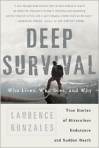
Rule One: Perceive and Believe
Admit you are really in trouble and you are going to get yourself out.
Rule Two – Stay Calm and Use Your Anger
Let your angry motivate you which can make you fell sharper. Manage your pain.
Rule Three – Think, Analyze, and Plan
Quickly organize, setup routines, and institute discipline.
Rule Four – Take Correct, Decisive Action
Be willing to take risks to save yourself and others. Be bold and cautious simultaneously. Break down large jobs into small, manageable tasks. Moment by moment, hour to hour, and day by day.
Rule Five – Celebrate Your Success, even the smallest.
Count your blessings.
Rule Six – Be a Rescuer, Not a Victim
Do what you do for someone else – have a higher motive.
Rule Seven – Enjoy the Survival Journey
Find something to enjoy, some way to play and to laugh. Use the intellect to stimulate, calm, and entertain the mind.
Rule Eight – See the Beauty
Look for the wonder in the small things around you.
Rule Nine – Believe that You Will Succeed
Your will to live and to get through becomes firmly fixed.
Rule Ten – Surrender
It is a resignation without giving up. It is survival by surrender.
Rule Eleven – Do Whatever Is Necessary
Have a reason to live and bet everything on yourself. Don’t over or under estimate your abilities. Believe that anything is possible and act accordingly.
Rule Twelve – Never Give Up
If you are alive, there is always one more thing that you can do. Accept that the environment is constantly changing and know you must adapt. When you fall, pick yourself backup and start the entire process over again. You are in a transformational journey.
What to Do Right Now.
Here are a few things that you might consider doing right now for yourself and your family.
- Payoff your credit card balances. Most of us cannot do this all at once. As you work on the minimum payments of each card, strive to pay off the lowest/smallest balance first. Then put that paid card’s minimum payment together with the second lowest card balance payment. Continue until all cards are paid off. This all assumes that you will not continue to make new charges. This reduction of expensive debt should be your first order of business. Pay down these balances even before considering any retirement savings or stock market investments.
- Budgeting and staying on one is lots of work. It is harder for some than others. Everyone should know where your hard-earned money is going. If you do that is a good thing, because you are in the position to make changes as needed. By knowing, you can look for ways to save money and set aside some for a “rainy day”. One of my favorite websites that might be helpful is http://www.moneyrulesdebtstinks.com [Have fun with the process.]
- As you control your spending and pay off expensive credit card debt, you should begin to set aside a few extra dollars. Place your extra dollars in some type of “interest-bearing” account. Shop around among the various banks and credit unions for the best rates. As of July 2009, The Bank of Georgia in Peachtree City has a checking account that earns 5% on deposits upto $25,000. Not bad when many are offering very little to nothing. Today some of the banks are not that stable due to commercial loans losses and other bad investments. Georgia has more than its share of failed banks. Deposits are FDIC insured, but best to do your homework and investigate. The general advice I hear is to work toward a balance of 6-months of your earnings into savings. Each of us should do what we can with what we have. If you manage one-month of earnings in savings, you are ahead of most people. Just keep at it consistently over time and you will achieve the amount you need and feel comfortable with it.
- By now, you are ready to make a longer-term investment. Today, where to place your money for the long-term is uncertain. Many advisors and so-called experts are more than willing to “sell” you on their ideas for a substantial gains while minimizing the risk. There a few good financial advisors, but remember that no one has a crystal ball and no one knows the future. Do your own research. Think for yourself.
- A final word, whatever you decide to do, please don’t ignore common sense. Your personal finances are really all about common sense and are not to be gambled with. Some risk will be necessary. After you have eliminated your high-cost credit card debt, started a family budget, and built a 6-month reserve; you are ready to invest wisely.
Best to be prepared for whatever the future may hold.
The Age of the Unthinkable by Joshua Cooper Ramo

Ramo in his new book lays out a compelling challenge about a world under change. Though he speaks in terms of international diplomacy, much of his thinking can be applied to every organization and system. If nothing else, he calls for preparedness because change is coming whether we wish it or not or want it or not. What follows is a recap of some of his comments on the subject of change.
Change has always been around us and in our lives. You may have sensed that the frequency of change has quicken. Sometimes without warning, it “roars down upon us as an avalanche out of bounds and out of our control.” These numerous changes are causing once-given landscapes to disappear or reshape into unfamiliar forms.
The time has arrived for adaptive systems and organizations. The future will require flexibility and preparedness for the type of intense change ahead. We will see “maladaptive systems (which) might look good for awhile, but when they are hit with the unexpected, they react in ways that doom them.” These systems are “organized into instability.” Many are “blinded by optimism and confusion (by) using out-of-date and unrealistic models of the world (their world).” It is the small things that precipitate an avalanche of change that must run its course until its energy is spent. Unfortunately, “we are probably not going to see it until it is too late.”
Any “change produces unpredictability and surprise.” So when “we push for change – we have to prepare ourselves for the fact that much of what we’ll get is unpredictable.” The time has come “to accept growing complexity and ceaseless newness as givens.”
Our future will require “harder truth telling” and experimentation that takes us right to the very edge of collapse. We will need to focus on things that move & change and learn to ask unusual questions. “We should do the work of crisis before crisis becomes a reality.” Much of the change ahead of us “will be difficult. It will involve tremendous sacrifice.”
Finally, you should realize that any discussion of this book will be highly frustrating because you will typically find “only incomprehension or dismissal in your audience.” To understand what the central message of this book is about will require an “intellectual and spiritual leap” and for most that will be too much to ask.
This age is the only one we have. It is now our time to face a changing world unlike anything those before us dealt with. What will it demand of you and me?
Personal: I highly recommend this book. It should challenge your thinking and cause you to think thoughts that might surprise you. Please don’t dismiss it’s message too quickly. Bill Wyler
Bill Wyler
 More from Bill
- An error has occurred; the feed is probably down. Try again later.

-
Archives
- April 2025 (1)
- February 2025 (1)
- January 2025 (6)
- December 2024 (1)
- April 2024 (4)
- March 2024 (4)
- February 2024 (6)
- January 2024 (8)
- November 2023 (1)
- July 2023 (1)
- June 2023 (1)
- May 2023 (1)
-
Categories
-
RSS
Entries RSS
Comments RSS
 Reviews and Views