The Age of the Unthinkable by Joshua Cooper Ramo
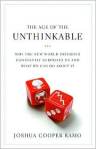
Ramo in his new book lays out a compelling challenge about a world under change. Though he speaks in terms of international diplomacy, much of his thinking can be applied to every organization and system. If nothing else, he calls for preparedness because change is coming whether we wish it or not or want it or not. What follows is a recap of some of his comments on the subject of change.
Change has always been around us and in our lives. You may have sensed that the frequency of change has quicken. Sometimes without warning, it “roars down upon us as an avalanche out of bounds and out of our control.” These numerous changes are causing once-given landscapes to disappear or reshape into unfamiliar forms.
The time has arrived for adaptive systems and organizations. The future will require flexibility and preparedness for the type of intense change ahead. We will see “maladaptive systems (which) might look good for awhile, but when they are hit with the unexpected, they react in ways that doom them.” These systems are “organized into instability.” Many are “blinded by optimism and confusion (by) using out-of-date and unrealistic models of the world (their world).” It is the small things that precipitate an avalanche of change that must run its course until its energy is spent. Unfortunately, “we are probably not going to see it until it is too late.”
Any “change produces unpredictability and surprise.” So when “we push for change – we have to prepare ourselves for the fact that much of what we’ll get is unpredictable.” The time has come “to accept growing complexity and ceaseless newness as givens.”
Our future will require “harder truth telling” and experimentation that takes us right to the very edge of collapse. We will need to focus on things that move & change and learn to ask unusual questions. “We should do the work of crisis before crisis becomes a reality.” Much of the change ahead of us “will be difficult. It will involve tremendous sacrifice.”
Finally, you should realize that any discussion of this book will be highly frustrating because you will typically find “only incomprehension or dismissal in your audience.” To understand what the central message of this book is about will require an “intellectual and spiritual leap” and for most that will be too much to ask.
This age is the only one we have. It is now our time to face a changing world unlike anything those before us dealt with. What will it demand of you and me?
Personal: I highly recommend this book. It should challenge your thinking and cause you to think thoughts that might surprise you. Please don’t dismiss it’s message too quickly. Bill Wyler
The Day the Mall Died
From an article by Anthony Cherniawski…
“Our consumption-driven society is being turned on its head, leaving household names staring down the barrel of bankruptcy. So many thing we have accepted as ‘absolute givens’ are goint to be stressed to the breaking point. One of them is the MALL – that icon of consumption itself. In fact, on April 16, 2009, ‘The MALL’ as we know it actually died. That was the day Chicago-based General Growth Properties (GGP) – the second-largest mall owner in the United States – filed for bankruptcy in federal court.”
Refer to http://financialsense.com/fsu/editorials/cherniawski/2009/0626.html.
Personal: Some say our generation will see “ghost malls” across this land – vacant store fronts where retail businesses brought products and services to US consumers but cannot because the profits are no longer there.
Inflation and the Dollar
In an article by Sol Palha, several interesting thoughts on higher inflation were made. You can see the entire article by Sol Palha of Tactical Investor at Financial Sense University (http:..www.financialsense.com/fus/editorials/ti/2009/0626.html).
Some of the items that interested me were….
- Inflation is defined as an increase in the supply of money and not an increase in the cost of goods.
- A direct result of inflation is an increase in the price of goods. It is a symptom but not the cause.
- Because the money supply has dramatically risen in the last 12 months, it appears that we have drug addicts driving the printing press to the breaking point.
- Hyperinflation is moving closer to a reality with the passage of each day.
- The next 6-9 years are going to produce profound changes. These changes will be so extreme and deep that it will literally stun the unprepared, for the majority have not and will most likely never again be exposed to such dramatic forces again in their life times.
- What should we do?
1. Eliminate all debt (or as much as possible as quickly as possible).
2. Live 1 to 2 standards below your means (choose to live at a lowest standard of living now, before it may be pressed upon you).
3. Save the difference (produce more than you consume and put aside the difference into savings).
4. Invest in bullion and commodities (if you invest at all, do so where you think best. There are many “advisers” with various opinions as to where your hard-earned money should go. But you may want to continue approaching matters of personal finances cautiously).
7 Deadly Scenarios by Andrew F. Krepinevich
I found this book to be a good read on possible threats to America. Even the background information that the author shared was very informative about systems, processes and how decisions or indecisions are made. For good or bad, the author was very clear about how we find ourselves at these crossroads. On page 250-251, he wrote a timely quote: “But let’s not be too harsh on the political leaders. In our democracy, dear reader, the people get the government they deserve. Our inattention, our intellectual laziness, our unwillingness to demand more of our leaders than platitudes paved the way to our current difficulties. If you want to know (who is responsible for this or that problem or crisis) just look in your mirror.”
Of the 7 scenarios, the author stated in an interview that he thought that the Collapse of Pakistan was most likely and that the War on the Global Economy was least likely. Every chapter lays out an intriguing situation that we hope our national leaders are thinking about, but current events seem to indicate that is not true. It is a book that does read like a thriller. I’m pleased to recommend it to you.
Bill Wyler
Kondratieff Winter (Economic Depression)
In an article by Tim W. Wood titled “Warning II!” dated June 19, 2009, he makes the point that there is no logical reason to see the economy in an optimistic view. Wishing that the worst is behind us is in his opinion just a false optimism that will eventually cost the average investor dearly. Their greed will keep them in the stock market trying to gain back their losses.
Mr. Wood believes that we are in the midst of a Kondratieff Winter. Probably most of us are not that familiar with K-wave theory. The following explanation comes from the website (http://www.kondratieffwinter.com/kw_wave.html).
The Kondratieff Wave is an economic theory that states that Western capitalist economies are susceptible to extreme performance volatility as they expand and contract over the years. Unlike what is referred to as the business cycle, the Kondratieff Wave holds that these fluctuations are in fact part of a much longer cycle periods known as “super cycles” that last between 50-60 years or longer depending upon factors such as technology, life expectancy, etc. and thus must be examined over their entirety to be best understood. The of phases that are likened to the seasons:
- Spring – inflationary growth phase, which sees the expansion of production, affluence, falling unemployment, rising wages and so on. This growth phase lasts about 25 years.
- Summer – recession. Growth reaches the limits of resources. There’s a drop in production, a rapid rise in unemployment and a back-lash against an economy of abundance. This phase last 3-5 years.
- Autumn – deflationary growth, selective industry production, innovation, rapid increase in debt as society orientates itself towards consumption. This phase can last 7-10 years.
- Winter – depression, the economy contracts sharply, there’s an exhaustion of accumulated wealth. Kondratieff viewed this phase as a time of cleansing when the economy can recover from times of excess and lay the foundation for future growth. He considered this phase would be characterized by a 3-year collapse followed by 15 years of deflation and quiet innovation. This is the phase that Wood believes that we are in now.

Personally, allow me to recommend an excellent book written by William Strauss and Neil Howe, “The Fourth Turning”. These authors show how history occurs in cycles. According to Strauss and Howe, we have entered into the 4th turning or crisis cycle of history which lasts for about 20 to 25 years. Notice that the 3-year collapse followed by 15 years of deflation is close to their 20-year cycle. Interesting.
Bill Wyler
Bill Wyler
 More from Bill
- An error has occurred; the feed is probably down. Try again later.

-
Archives
- April 2025 (1)
- February 2025 (1)
- January 2025 (6)
- December 2024 (1)
- April 2024 (4)
- March 2024 (4)
- February 2024 (6)
- January 2024 (8)
- November 2023 (1)
- July 2023 (1)
- June 2023 (1)
- May 2023 (1)
-
Categories
-
RSS
Entries RSS
Comments RSS
 Reviews and Views